Decision Analysis
This section evaluates the proposed business model through Total Quality Control (TQC), operational trend analysis, and structured decision analysis. The objective is to determine whether the redesigned model presents a sufficiently strong case for upper management to approve investment.
Total Quality Control Analysis
Total Quality Control is applied in the proposed model to ensure that production quality, process consistency, and customer expectations remain aligned throughout the operating cycle. In a solar manufacturing environment, quality failures can affect yield, delivery timing, customer confidence, and long-term financial performance.
The redesigned process introduces quality checkpoints at intake, scheduling, manufacturing, inspection, and post-production review. This closed-loop control structure allows defects and inefficiencies to be identified earlier, reducing downstream impact.
Figure 10. Operational Quality Trends (TQC Metrics)
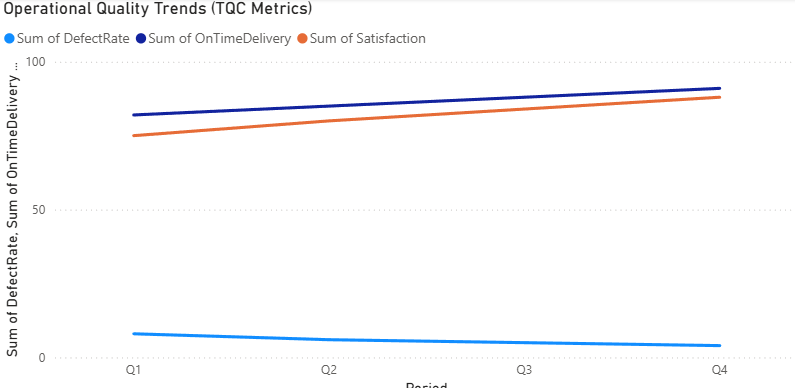
The quality control trends indicate a reduction in defect rates over time, while on-time delivery and customer satisfaction increase. This demonstrates that Total Quality Control improves both operational efficiency and customer experience.
Current and Future Operational Trends
Current industry conditions indicate continued pressure on manufacturers to improve production efficiency, supply chain resilience, and delivery reliability. These pressures are expected to continue as competition, customer expectations, and demand variability increase across the solar market.
Future success will therefore depend not only on product demand, but also on the ability to control cost, maintain quality, and execute reliably at scale. For that reason, an operational model emphasizing process discipline, quality control, and decision visibility is likely to provide a long-term competitive advantage.
Decision Tree Analysis
The final investment decision can be represented through two primary branches: invest in the redesigned operating model or maintain the current state. Under the investment path, projected outcomes include higher throughput, stronger quality control, better customer performance, improved workforce stability, and improved scalability. Under the non-investment path, known inefficiencies remain in place and continue to constrain growth.
Figure 11. Decision Outcome Probability Distribution
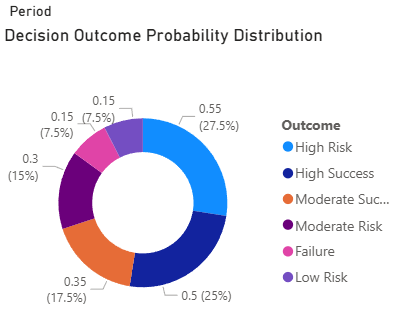
The decision outcome distribution illustrates that the probability of success under the investment scenario outweighs the risks associated with maintaining the current operational model.
Final Recommendations for Upper Management
- Approve implementation of the redesigned operating model.
- Prioritize supplier coordination, production visibility, and inventory control during early implementation.
- Establish TQC metrics and management dashboards before full-scale rollout.
- Use five-year milestone tracking to align operational, customer, workforce, and financial objectives.
- Continue using probability-based decision support for future scaling and capital planning decisions.
Based on the full body of analysis developed across the project, the proposed model should be accepted because it addresses existing process weaknesses, improves quality control, supports measurable growth planning, strengthens customer retention logic, and aligns operational performance with market demand trends.
Power BI Workspace
The interactive Power BI dashboard supporting this analysis is available through the Power BI Dashboard page.