Customer Profile, Expansion Challenges, and Retention Strategy
This section evaluates the customer-facing human factors of the proposed First Solar business model. The analysis focuses on customer segmentation, market expansion barriers, retention behavior, and revenue impact. The purpose of this section is to demonstrate how customer intelligence can be used to support stronger acquisition, improved retention, and more predictable long-term growth.
The proposed customer strategy builds on the operational and pricing foundations established in the earlier sections of this project. As production reliability, fulfillment timing, and quality control improve, the organization is better positioned to attract new accounts, reduce customer loss, and strengthen long-term commercial relationships.
Primary Customer Groups
First Solar serves a customer base that includes utility providers, project developers, commercial and industrial buyers, public sector organizations, and engineering, procurement, and construction partners. These customer groups do not behave identically. Each segment has different expectations regarding contract value, purchasing frequency, implementation complexity, and retention likelihood.
For that reason, customer segmentation is necessary to support more targeted solicitation, more efficient account management, and stronger retention planning. A generalized growth strategy would weaken market precision, while a segmented strategy improves the ability to align pricing, sales support, and service responsiveness to the needs of each customer type.
Figure 12. Projected Customer Accounts by Segment
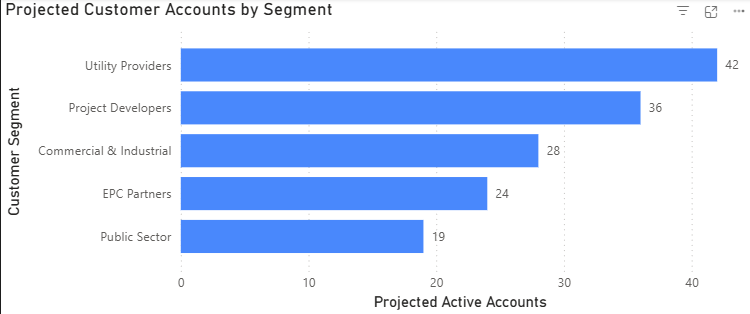
The segmentation analysis indicates that utility providers and project developers represent the largest projected account groups, while commercial and industrial buyers, EPC partners, and public sector entities remain important supporting segments. This distribution suggests that customer growth strategy should prioritize high-volume segments without ignoring the stabilizing value of secondary markets.
The visual also shows that customer expansion should not be treated as a single market behavior. Utility-scale and development-focused accounts are likely to drive larger growth opportunities, while secondary segments provide diversification and resilience. This insight supports a segmented solicitation strategy rather than a uniform marketing approach.
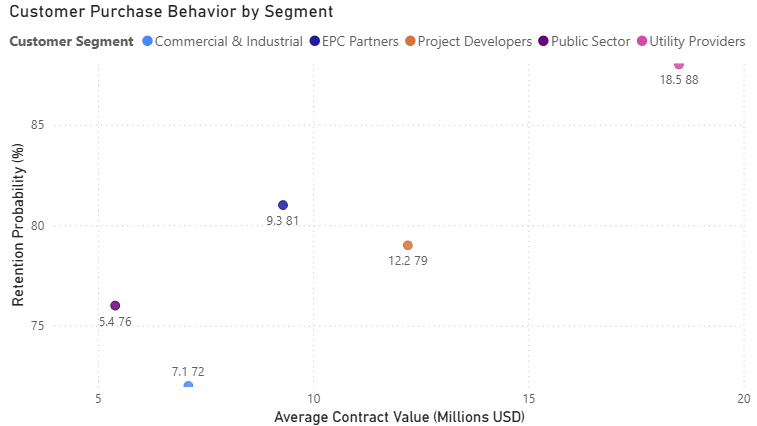
Figure 13. Customer Purchase Behavior by Segment
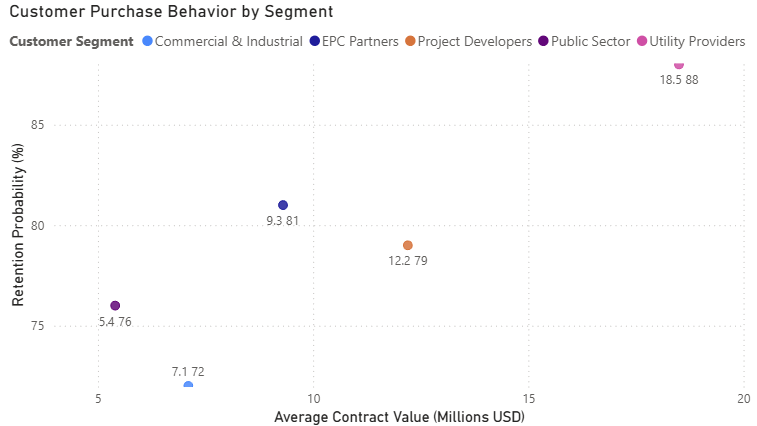
The purchase behavior analysis compares projected contract value to projected retention probability across customer segments. This visual demonstrates that higher-value segments also tend to provide stronger long-term retention potential when supported by consistent fulfillment, pricing stability, and account management responsiveness.
This finding is important because it shows that customer retention is not only a service issue, but also a financial issue. Segments with stronger contract value and stronger retention potential should receive more focused relationship management, while segments with lower retention likelihood should be supported through pricing clarity, improved communication, and stronger post-sale follow-up.
Primary Barriers to Customer-Base Growth
Two primary challenges limit customer-base expansion under the current and transitional operating environment. The first challenge is conversion loss across the sales funnel. The second challenge is customer churn caused by inconsistent fulfillment performance, delayed communication, or perceived execution risk.
These barriers reduce revenue opportunity in different ways. Funnel loss prevents the organization from converting qualified interest into signed contracts, while churn reduces the lifetime value of customers already acquired. Together, these issues create a measurable drag on growth and weaken long-term market efficiency.
Figure 14. Projected Customer Acquisition Funnel
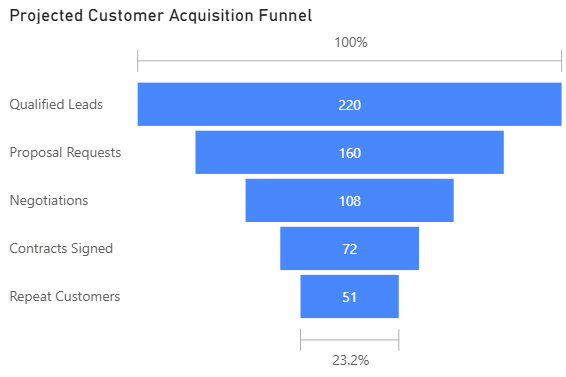
The customer acquisition funnel shows that a substantial reduction occurs between qualified leads, proposal requests, negotiations, signed contracts, and repeat-customer status. This drop-off pattern demonstrates that customer interest alone is not sufficient to produce sustained growth.
The largest challenge illustrated by this visual is conversion inefficiency. Customers may enter the pipeline with interest, but contract closure depends on pricing confidence, response speed, coordination, and operational credibility. A proposed solution is the introduction of stronger proposal support, more standardized account follow-up, and tighter coordination between sales, operations, and customer service. These changes are expected to improve proposal-to-contract conversion and increase revenue capture.
Figure 15. Projected Customer Churn Reduction Over Time
The projected churn trend shows a steady decline over time following process improvements. This indicates that stronger execution, better communication, and more reliable customer support can reduce customer loss and strengthen retention outcomes.
The second challenge illustrated by this visual is customer attrition. Even if acquisition performance improves, long-term growth will remain limited if customers do not remain with the organization. The proposed solution is a retention model centered on account responsiveness, fulfillment reliability, structured service follow-up, and proactive issue resolution. These improvements support stronger confidence, encourage repeat business, and increase customer lifetime value.
How the Proposed Strategy Supports Revenue Growth
The proposed customer strategy supports increased revenue through two reinforcing mechanisms. First, improved conversion performance allows a greater percentage of qualified opportunities to become signed contracts. Second, reduced churn increases the duration and value of existing customer relationships. Together, these mechanisms raise both the volume and durability of revenue generation.
The earlier phases of this project established that operational redesign, quality control, and pricing discipline improve execution reliability. This section extends that logic by demonstrating that stronger execution directly supports customer retention and customer growth. A more reliable operating model improves customer confidence, which improves conversion probability, which in turn supports repeat business and stronger long-term revenue.
| Growth Factor | Business Effect | Revenue Impact |
|---|---|---|
| Improved conversion rate | More qualified leads become signed contracts | Increases near-term sales volume |
| Lower churn rate | More customers remain active over time | Improves recurring and repeat revenue |
| Better customer segmentation | Resources are focused on higher-value segments | Improves contract mix and margin potential |
| Stronger account follow-up | Service quality and trust improve after the sale | Raises customer lifetime value |
| Integrated customer strategy | Acquisition and retention are aligned with operations | Supports sustainable long-term growth |
Customer Strategy Recommendation
Based on the projected customer analysis, the organization should adopt a segmented customer-growth strategy supported by conversion management and retention controls. This strategy is more consistent with the redesigned operational model than a broad, non-targeted solicitation approach.
In practical terms, management should prioritize high-value segments, reduce sales funnel inefficiencies, improve post-sale follow-up, and use retention trends as a recurring management metric. These actions would strengthen customer growth while supporting the broader business process improvements proposed throughout the project.